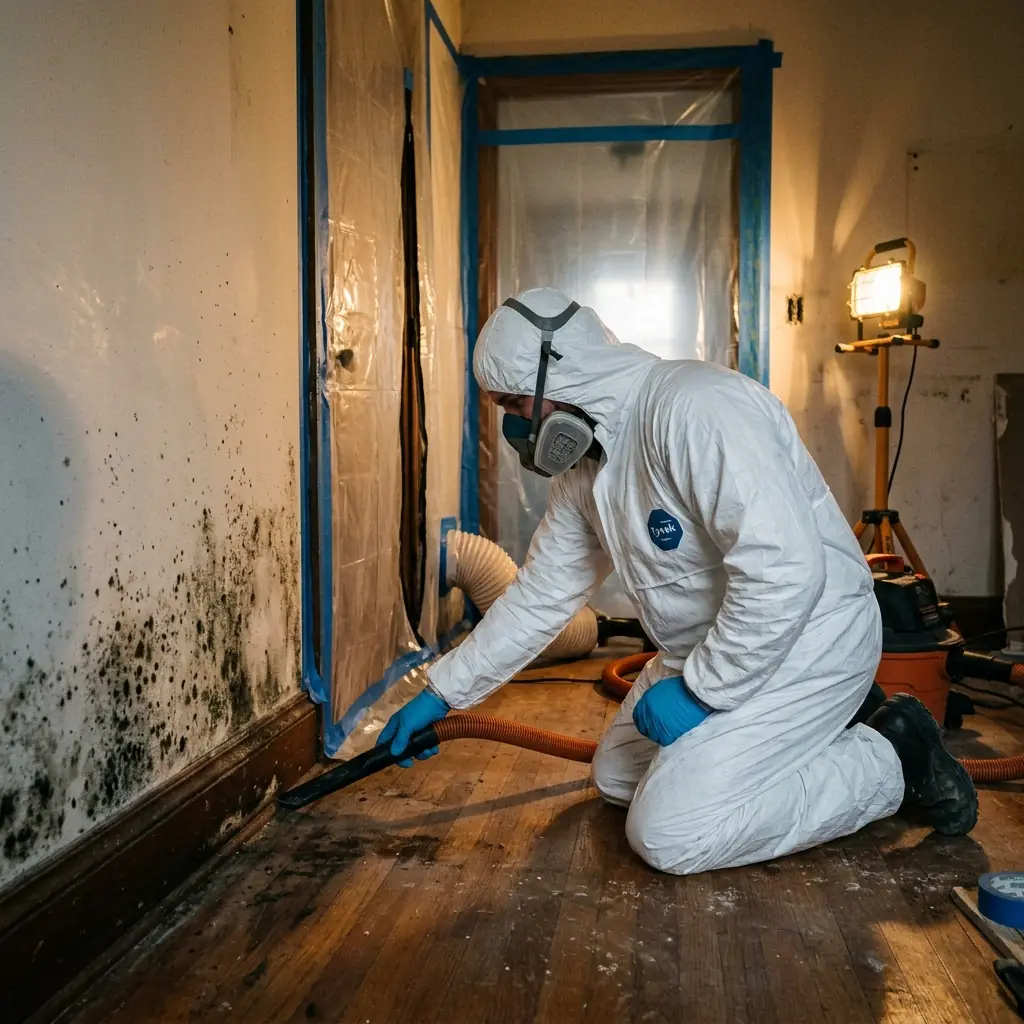
Mold can start growing within 24 to 48 hours after water damage. Our crew removes mold safely, to the ANSI/IICRC S520 standard, and addresses the moisture source that caused it.
Live dispatcher answers 24/7. Certified crew on the way to your Haltom City property as soon as one is available.
Dri-Eaz LGR dehumidifiers, Velo PRO air movers, and FLIR thermal imaging on every truck.
Fast extraction and structured drying stop mold before it starts, typically within 24 to 48 hours.
FLIR thermal mapping and moisture meters document every affected zone for your insurance adjuster.
We inspect the affected area and seal it off to prevent spores from spreading during removal.
Affected drywall, insulation, or other porous material is removed and disposed of properly.
Remaining surfaces are treated to kill residual mold and prevent regrowth.
We confirm the area is fully dry and document the job for your records.
Texas requires a TDLR Mold Remediation Contractor license for any mold remediation project, and you can verify any contractor's license directly with the state. We hold that license and pair it with IICRC S520 mold-specific certification for every job.
Mold remediation done right addresses both the visible growth and the moisture source behind it. Skipping the second part means the mold comes back.
Live dispatcher every call, day or night. No voicemail, no answering service.
Vetted local technicians working to the ANSI/IICRC S500 drying standard on every job.
From extraction to mold prevention, one crew handles the full restoration process.
Locally operated in Haltom City, not a franchise call center. We know the city's older housing stock and where moisture tends to collect after a water-damage event.
Most mold calls in Haltom City fall into one of two patterns.
Problem: Mold can take hold within 24 to 48 hours if a water-damaged area isn't fully dried, even after the visible water is gone.
Our Solution: We assess the full extent of moisture intrusion, not just the visible mold, and remediate the entire affected area to the ANSI/IICRC S520 standard.
Problem: A slow, hidden leak can grow mold behind walls or under flooring for weeks before anyone notices a musty smell.
Our Solution: FLIR thermal imaging locates the hidden moisture source so remediation addresses the cause, not just the symptom.
Problem: A clogged or damaged sewer line can push contaminated water back into a home through drains or fixtures, often with little warning.
Our Solution: We contain the area, extract the contaminated water, and fully disinfect before drying begins.
Problem: A sewage backup introduces bacteria and contaminants throughout the affected area, posing a real health risk if handled without the right protective equipment.
Our Solution: We contain the area, remove contaminated materials, and disinfect with EPA-registered products before any restoration work begins.
Problem: A musty smell can persist even after a water-damaged area tests dry, usually from residual moisture trapped in porous materials.
Our Solution: Hydroxyl treatment and HEPA air scrubbing break down the odor source rather than just masking it with a fragrance.
Yes. Texas requires a TDLR Mold Remediation Contractor license for mold remediation work. Ask any company you're considering to show their license, since it's a verifiable credential, not just a claim.
Mold can begin growing within 24 to 48 hours in the right conditions. The faster water is extracted and the area is dried, the lower the chance mold takes hold.
Mold coverage is often limited to a cap, typically in the range of $1,000 to $5,000, and only when the mold resulted from a covered water-damage event. Check your specific policy for the exact figure.
Many homeowner policies exclude sewer backup unless you've added a specific endorsement. Check your policy and call us either way, since documentation of the damage matters regardless of which way the claim goes.
No. Category 3 water carries bacteria and contaminants that require protective equipment and proper disposal procedures most homeowners don't have on hand. Call a certified crew rather than handling it yourself.
A lingering smell usually means residual moisture or bacteria is still present in a porous material, like drywall or subflooring, even if the area tests dry on the surface. Odor removal treats the actual source instead of just masking it.
ANSI/IICRC S520 Mold Standard
Mold Containment and HEPA Filtration
OSHA Compliant, Vetted Local Technicians in Texas
Locally operated in Haltom City, TX, not a franchise
Skip the form — call Haltom City Water Restoration directly for the fastest response.
Available 24/7 · No-obligation estimate · Fast local response